
Red-Foot Tortoise (Babies) care sheet
Chelonoidis carbonarius
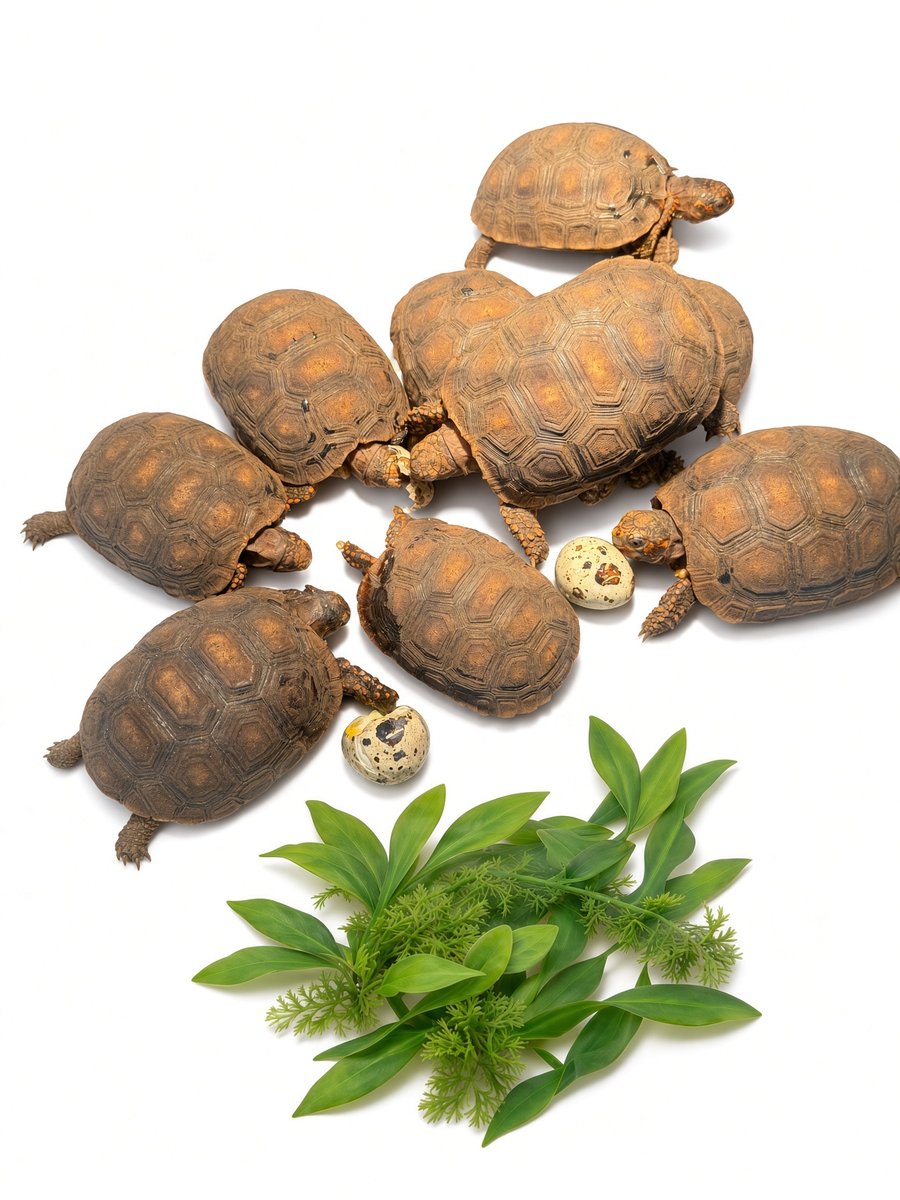
Overview
Red-foot tortoises are humid-forest omnivores from northern South America. Compared with Mediterranean or arid tortoises, they tolerate — and need — more humidity, and they naturally eat more fruit and occasional animal protein. Babies need stable warmth, moisture, UVB, calcium, and a diet that is mostly plants with measured protein.
Enclosure
- Babies do well in a warm, humid tortoise table or enclosed vivarium with excellent ventilation (closed boxes without airflow cause respiratory issues).
- Provide multiple hides (warm and cool), a shallow water dish large enough to soak in, and room to walk.
- Upgrade space as they grow; adults need substantial floor area (pens/outdoors when climate-safe).
- Outdoor supervised time in a secure pen is excellent when weather and predators allow.
Water / Temps
Offer fresh water daily. Soak babies a few times weekly in shallow lukewarm water to support hydration (supervise).
“Water / Temps” for tortoises means ambient/basking gradients and drinking/soaking water — not a swimming aquarium.
Substrate
Use moisture-friendly, diggable substrates such as coconut coir, cypress mulch, or soil/coir mixes that hold humidity without becoming anaerobic mud. Provide a moist hide packed with damp moss/coir. Avoid calcium sand, pure sand long-term, cedar/pine shavings, and dusty substrates.
Lighting / UVB
Provide a high-quality UVB source (commonly 10–12% fluorescent T5 HO or equivalent mercury-vapor setups sized correctly) ~12 hours/day with shaded areas. Red-foots use shade in nature — give a UV gradient, not a single “blast” with nowhere to retreat. Pair UVB with dietary calcium. Replace bulbs on schedule; output fades before visible light dies.
Diet & feeding amounts
Omnivore. A practical captive target many vets/keepers use: majority leafy greens/weeds, some vegetables, fruit more often than arid tortoises but still not a candy bowl, plus small amounts of animal protein about weekly to every 1–2 weeks.
- Babies: Offer fresh food daily (morning). A common guide is roughly a portion about the size of the shell, or what they finish in ~15–30 minutes — then remove leftovers.
- Protein examples: tiny amounts of hard-boiled chicken/quail egg, gut-loaded insects, or moistened low-fat cat food as occasional items (not daily).
- Dust greens with calcium (no D3 if strong UVB outdoors; with D3 if indoor UVB is limited — follow vet guidance) several times weekly; use a multivitamin less often.
Foods they love
- Weeds/greens: dandelion, plantain, sow thistle, hibiscus leaves/flowers, mulberry, etc. (pesticide-free)
- Dark leafy salads (romaine, collard, mustard, endive) in rotation
- Fruits in moderation: fig, berry, papaya, mango, apple — more OK than for sulcatas, still not the base diet
- Flowers: hibiscus, nasturtium
- Occasional insects / egg as protein enrichment
Foods to AVOID (and why)
- Daily high-protein meat diets: kidney/liver stress, shell pyramiding risk with other husbandry errors.
- Dog/cat food as a staple: too rich; occasional tiny amounts only if used at all.
- Iceberg lettuce, bread, dairy, processed junk
- Toxic plants (oleander, avocado leaves/fruit for many reptiles, etc.) — when unsure, don’t feed.
- Only fruit: unbalanced sugars/fiber ratio even for this fruit-tolerant species.
What not to do
- Don’t keep them desert-dry like a sulcata/leopard setup.
- Don’t skip UVB/calcium indoors.
- Don’t use heat rocks.
- Don’t house wet + cold (respiratory disease risk).
Health signs
Watch for bubbly nose, open-mouth breathing, swollen eyes, soft shell, pyramiding, diarrhea, parasites (vet fecal exams), and appetite loss. Quarantine new tortoises. Hand hygiene matters.
Quick facts
Learn more: the red-foot tortoise from hatchling to adult
Red-foots bridge forest floor and fruiting tree: they shelter in humid cover, wander through mosaic habitats, and eat a more varied diet than many desert-associated tortoises.
Names, taxonomy, and regional variation
Chelonoidis carbonarius is a South American member of Testudinidae, the true tortoise family. The closely related yellow-foot tortoise, Chelonoidis denticulatus, is larger and has different coloration. Red-foots vary geographically in adult size, shell shape, head color, and the pale midline on some plastrons. Sex or locality cannot be established reliably from a hatchling photo alone.
Native range and habitat
Their broad range extends through much of tropical South America east of the Andes, with nearby island populations as well. They occupy humid and dry forests, forest edges, savanna mosaics, scrub, and grasslands rather than one uniform “rainforest” habitat. Shade, fallen fruit, leaf litter, hollows, and seasonal plant growth guide daily movements. They do not naturally hibernate through a cold winter.
Conservation, trade, and escape prevention
Recent specialist assessments have moved the species from no global IUCN rating to Endangered, reflecting serious declines from habitat loss, hunting, collection, and other pressures across a broad but uneven range. International trade is regulated under CITES Appendix II. Buy captive-bred tortoises with proper records, maintain secure outdoor barriers in Florida, and never release one. Humidity and warmth do not make an unsupervised backyard automatically safe: dogs, raccoons, lawn chemicals, drowning hazards, heat, and escape gaps remain real risks.
Anatomy, senses, and daily behavior
- Domed shell: Bone is fused into the shell, with living keratin scutes outside. The shell has sensation; drilling, painting, or striking it causes harm.
- Colored scales: Red, orange, or yellow markings on limbs and head vary by individual and region.
- Beak and digestion: A horny beak crops vegetation and other foods. Gut microbes and a suitably warm body help process fibrous plant material.
- Senses: Smell helps locate aromatic food, while vision and ground or airborne vibrations help tortoises detect food and activity nearby. Chelonian color discrimination is well supported, although specific visual pigments have not been confirmed for every species. They can detect some sounds, but name recognition should not be assumed.
Size, growth, and longevity
Hatchlings are commonly only about 3.5–5 cm (1.4–2 in) long. Depending on locality and sex, adults often reach 30–40 cm (12–16 in), with some larger. Males frequently develop a narrower waist, longer tail, and more concave plastron, but young tortoises cannot be sexed confidently. Smooth growth, adequate hydration, varied food, calcium, and appropriate UVB matter more than maximum speed. Many live 40–60 years or longer in excellent care.
Wild diet and ecological role
Red-foots eat grasses and broadleaf plants, shoots, flowers, fallen fruit, fungi, insects, worms, snails, and occasional carrion. The mix shifts with rainfall and availability, and plant material remains the bulk of the diet. Fruit consumption and movement can disperse viable seeds, making these tortoises participants in forest regeneration. In captivity, fruit is appropriate in measured amounts—not an unlimited dessert bowl.
Reproduction and development
Courtship can include head bobbing, circling, and male clucking sounds. Males may compete or attempt to flip one another, while persistent mating attempts can stress females. The female excavates a soil nest and may lay roughly 2–15 eggs per clutch depending on size, condition, and population, with multiple clutches possible. Incubation varies greatly with temperature and moisture, commonly around 105–202 days, with about 150 days often reported. Hatchlings use an egg tooth to emerge and receive no parental care. Laboratory studies show temperature-dependent sex determination: higher suitable incubation temperatures favor females. Excessively high temperatures can be lethal, so “warmer is better” is unsafe incubation advice.
Temperament and handling
Red-foots are often curious and food-motivated, but each individual has different tolerance. Approach at shell level rather than casting a predator-like shadow, and avoid flipping or repeatedly lifting. When transport is necessary, support the entire shell and body with two hands close to a secure surface. A tortoise withdrawing, hissing air out, or scrambling away is communicating stress, not playing.
Health problems and what to watch
- Respiratory illness: Nasal bubbles, mucus, open-mouth breathing, lethargy, or appetite loss require warmth review and prompt exotic veterinary attention.
- Shell disease: Softening, uneven growth, pyramiding, pits, discoloration, or wet lesions can involve nutrition, bone metabolism, humidity, trauma, or infection.
- Parasites and digestive trouble: Weight loss, abnormal stool, straining, or a prolapse needs professional assessment. Routine deworming without testing can be harmful.
- Egg binding: Repeated digging, straining, weakness, or collapse in a female is an emergency.
What consistently works for babies
Experienced keepers prioritize a humid but ventilated nursery, clean shallow water, a warm hide, low climbing hazards, and close weight tracking. Mist or moisten appropriate substrate while avoiding a permanently flooded bottom. Offer finely chopped varied greens, controlled fruit, and small protein portions rather than forcing rich growth. Quarantine newcomers, disinfect shared tools, and supervise outdoor grazing where pesticides and toxic ornamentals are excluded. A hot dry spotlight without retreat can make a baby hide all day; correct the gradient instead of assuming it is lazy.
Myths and memorable facts
- Myth: “Tortoises feel nothing through the shell.” Fact: The living shell and overlying tissue can sense touch and injury.
- Myth: “Red-foots are strict vegetarians.” Fact: Wild animals opportunistically consume fungi and animal matter in addition to mostly plant foods.
- Myth: “Humid means soaking wet.” Fact: Warm humidity with airflow and dry resting choices is the goal.
- Fun fact: Courting males make audible clucks, an unexpected vocalization from such a quiet-looking animal.