
Albino Snapping Turtle (Babies) care sheet
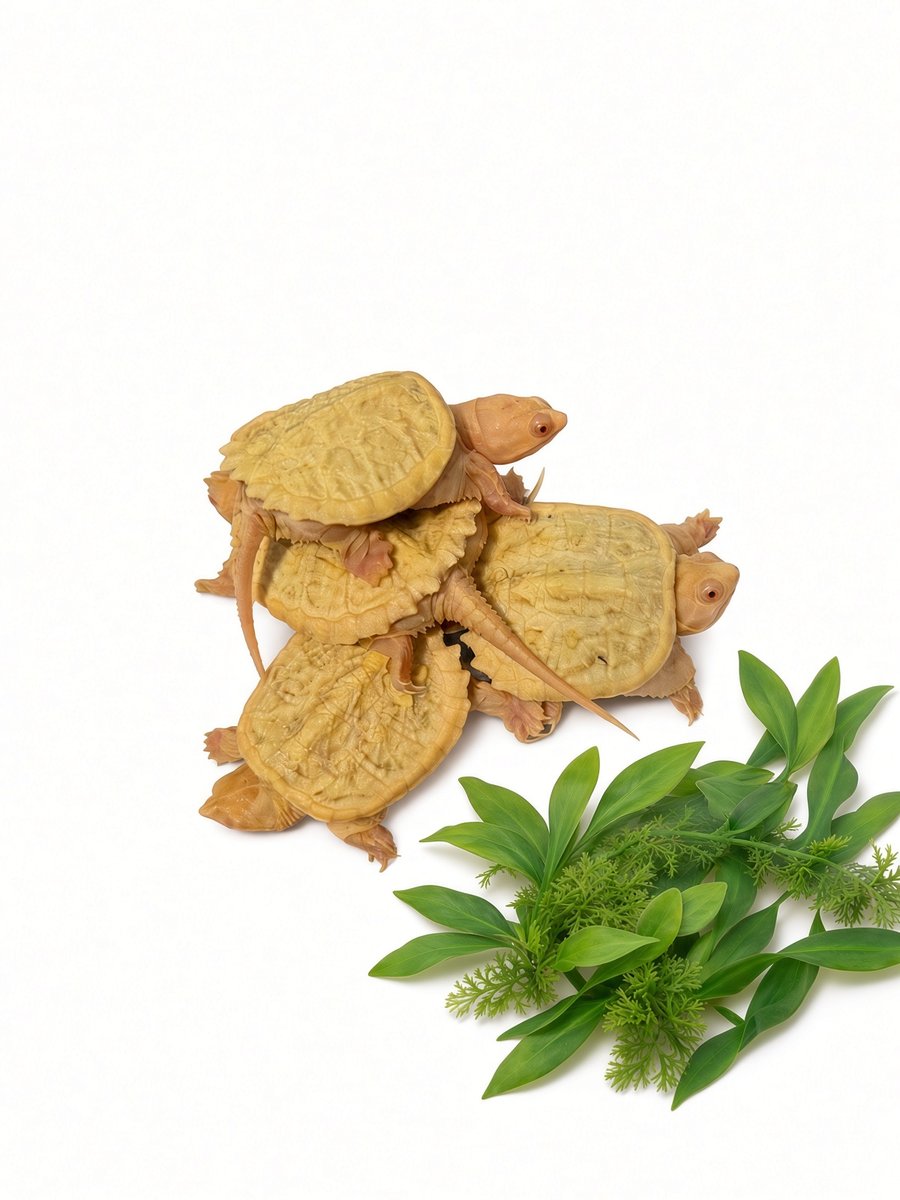
Common snapping turtle (albino morph) · Chelydra serpentina
Overview
Albino common snapping turtles are a color morph of Chelydra serpentina — same powerful jaws, same huge adult size, same long lifespan. Babies are manageable; adults need pond-scale housing. Plan the end size before you fall in love with the hatchling.
Enclosure
- Babies: A 20-gallon long can start a hatchling briefly, but upgrade quickly. Prioritize footprint and filtration.
- Adults: Often 100–300+ gallons, stock tanks, or outdoor ponds (secure, escape-proof, predator-proof).
- Provide cover, visual barriers, and a place to rest with nostrils at the surface.
- Powerful filtration is mandatory — snappers are messy predators.
Water / Temps
Hatchlings can drown in overly deep, featureless water. Give gradual depth, climbing structure, and easy surface access.
Substrate
Snappers naturally bury in soft bottoms. For babies, fine sand deep enough to cover the whole body supports natural behavior — clean it diligently. Many keepers use bare-bottom for hygiene, especially as animals grow. If using gravel, pieces must be far larger than the head to reduce swallowing risk. Avoid sharp substrates.
Lighting / UVB
Provide a day/night cycle. A basking lamp over a dry or shallow bask area plus UVB (or a combined mercury-vapor option) is recommended for captive aquatic turtles, especially indoors. Offer shade. Albinos can be light-sensitive — provide dimmer retreats.
Diet & feeding amounts
Omnivorous predators. Babies need frequent feeding; adults eat less often.
- Hatchlings: Daily or twice-daily small meals they finish quickly — earthworms, bloodworms, appropriately sized insects, quality turtle pellets, occasional lean fish pieces.
- Growing juveniles: Usually daily; watch body condition.
- Adults: Often every 2–3 days.
- Include some plant matter/aquatic greens for variety even though they prefer animal foods when young.
Guppies (and similar livebearers) as an occasional treat: Guppies are generally considered lower-risk for thiaminase than goldfish/rosy reds and can be an enrichment feeder occasionally — not a daily staple. Only use healthy fish from a clean, quarantined source (ideally home-cultured or from a known-healthy tank). Still gut-load/condition them and keep fish as a small part of a balanced turtle diet built around quality pellets, invertebrates, and appropriate plants/greens.
Foods they love
- Earthworms, nightcrawlers
- Crickets/roaches (gut-loaded), appropriately sized
- High-quality aquatic turtle pellets
- Occasional shrimp, tilapia strips, snails
- Some leafy greens / aquatic plants
Foods to AVOID (and why)
- Goldfish/rosy reds as staples: thiaminase, fat, parasites.
- Fatty processed meats, hot dogs, raw fatty scraps
- Wild-caught prey of unknown health
- Anything too large to swallow safely (choke/impaction)
What not to do
- Don’t underestimate adult size/bite strength — respect the animal; use hooks/tubs for adults.
- Don’t keep babies in deep empty tanks.
- Don’t cohabitate casually with fish/turtles that will be hunted or injured.
- Don’t release captives into Florida waterways.
Health signs
Watch for shell rot, fungus, buoyancy issues, lethargy, anorexia, injuries from décor/tankmates. Albino skin/eyes may need softer lighting. Exotic vet care recommended.
Quick facts
Learn more: the snapping turtle behind the albino color
Albinism changes pigmentation, not the species. The pale baby still carries the anatomy, instincts, longevity, and eventual strength of a common snapping turtle.
Taxonomy, names, and evolutionary history
The common snapping turtle, Chelydra serpentina, belongs to Chelydridae, a lineage with deep North American roots. It is distinct from the much larger alligator snapping turtle genus, Macrochelys. The small plastron, powerful head, ridged juvenile shell, and long saw-toothed tail are defining field clues. The Florida form was described as Chelydra serpentina osceola and has sometimes been elevated to Chelydra osceola. Current taxonomic checklists do not recognize it as a clearly distinguishable subspecies or separate species, so it belongs within C. serpentina. Southern Mexican and Central American forms are treated as separate species; avoid using their ranges as part of the common snapper’s native range.
Native range and habitat
The species naturally occupies much of eastern and central North America, from southeastern Canada through the eastern United States into Texas, the Gulf Coast, and Florida. Separate snapping-turtle species occur farther south in Mexico and Central America. It favors ponds, marshes, slow streams, lakes, and other waters with soft bottoms and concealment. Snappers tolerate varied conditions, including some brackish water, but this does not make polluted or chronically cold captive water acceptable.
Conservation, wild collection, and Florida law
Although still widespread, local populations suffer road mortality, wetland loss, persecution, pollution, and collection. Slow maturity means adults are especially important to population survival. Florida prohibits taking common snapping turtles from the wild because they may be confused with protected alligator snapping turtles; collecting wild freshwater turtle eggs is also prohibited. Florida’s freshwater-turtle rule, adopted in 2009, protects wild animals rather than banning lawful captive breeding. Aquaculture-raised turtles or documented captive-bred stock purchased from licensed vendors may be sold under the applicable aquaculture and wildlife rules. Retain receipts identifying the supplier, species, quantity, and purchase date, and verify current requirements before transporting or selling animals. International trade in the species is regulated under CITES Appendix II. Never move animals between waters or release unwanted turtles.
Anatomy and hunting adaptations
- Head and neck: A large head and extensible neck deliver a fast defensive strike. The hooked beak grips and tears food; these turtles have no teeth.
- Shell: Hatchlings and juveniles show three raised keels that become less dramatic with age. The reduced cross-shaped plastron leaves substantial soft tissue exposed.
- Tail and limbs: The long, crested tail and strong claws aid positioning and movement; neither is a handle.
- Bottom living: Snappers can remain submerged for extended periods and often bury with eyes and nostrils exposed. They surface to breathe and can also take in some oxygen through permeable tissues.
Size, growth, lifespan, and senses
Typical adult carapaces are roughly 20–37 cm (8–15 in), with larger individuals possible; body mass varies greatly with sex, region, and condition. They grow steadily rather than staying “tank sized.” Wild life expectancy is often around 30 years, with substantially longer records in managed care. Smell and chemical detection help locate food, vision detects movement, and touch and vibration inform responses to nearby activity. Defensiveness is strongest out of water, where the turtle cannot simply retreat.
Wild diet and seasonal behavior
Common snappers are opportunistic omnivores: aquatic plants, algae, insects, worms, crustaceans, mollusks, fish, amphibians, reptiles, birds, mammals, and carrion may all be eaten. Young animals actively forage more; larger turtles often ambush and scavenge. Activity rises in warm seasons. In cold portions of the range they overwinter underwater in a low-metabolism state, but tropical captive management must not impose an unnecessary chill or brumation cycle.
Reproduction and temperature-dependent sex
Mating occurs in water during the warmer months, and females travel onto land to dig flask-shaped nests in soil or sand. Clutches commonly contain roughly 20–40 eggs, though smaller and much larger clutches occur. Incubation often spans 9–18 weeks depending on temperature. Sex is influenced by incubation temperature, and females may store viable sperm for years. Hatchlings receive no parental care and face heavy predation.
Albinism genetics and what it does—and does not—mean
Albinism results from inherited disruption of melanin production. The particular albino line should be documented by the breeder. Many reptile albino traits are recessive, but a visible albino parent crossed to a known carrier of the same allele averages half albino offspring; two same-line albinos produce albino offspring. Unrelated pale or “albino” lineages may involve different genes, so no universal ratio should be promised without lineage records. Albino animals have reduced pigment in skin and eyes, often appearing pink or red-eyed; leucistic or hypomelanistic animals are not automatically albino. Reduced pigment may increase sensitivity to glaring light and reduces natural camouflage; it does not weaken the jaws, reduce adult size, or reduce space requirements.
Temperament and handling
Normal shyness in water and defensive behavior on land are not “meanness.” Never dangle fingers to test a feeding response, lift by the tail, or restrain an adult without training. Even a baby can scratch or bite. Use a secure plastic tub for movement and have an experienced reptile professional demonstrate safe support for larger animals. Frequent handling creates stress and injury risk.
Common medical problems
- Shell and skin disease: Ulcers, white fuzzy growth, foul odor, exposed tissue, and persistent softness require diagnosis and clean, corrected husbandry.
- Respiratory infection: Wheezing, mucus, open-mouth breathing, lethargy, and persistent abnormal floating are urgent warning signs.
- Metabolic or dietary disease: Improper UVB/calcium, excess rich food, and vitamin deficiencies can produce weakness, deformity, reddened tissue, tremors, or poor growth.
- Injury and parasites: Bites, swallowed objects, prolapse, or sudden weight loss warrant an exotic veterinarian, not an internet remedy.
Useful keeper experience, without the myths
Start with a simple, visible layout and shallow resting routes for babies; increase depth only as swimming competence is clear. Weigh and photograph growth regularly, feed measured portions, and avoid casual cohabitation—tails and feet resemble prey. A secure lid and grounded, guarded equipment prevent common accidents. Albino babies may approach food more confidently when lighting is not glaring and visual cover is available. Do not keep them in cramped containers to “control aggression” or assume a hatchling’s calm interaction predicts adult behavior.
Myths and memorable facts
- Myth: “A snapping turtle can bite a broom handle cleanly in half.” Fact: The bite is dangerous, but exaggerated damage claims are folklore, not a useful measurement.
- Myth: “Carry it by the tail because the shell is slippery.” Fact: Tail lifting can injure the spine.
- Fun fact: Females can store sperm and produce fertile eggs in later seasons without a recent mating.
- Fun fact: The three juvenile shell keels and serrated tail give babies a miniature prehistoric profile.