
Albino Red-Eared Slider (Babies) care sheet
Trachemys scripta elegans
Overview
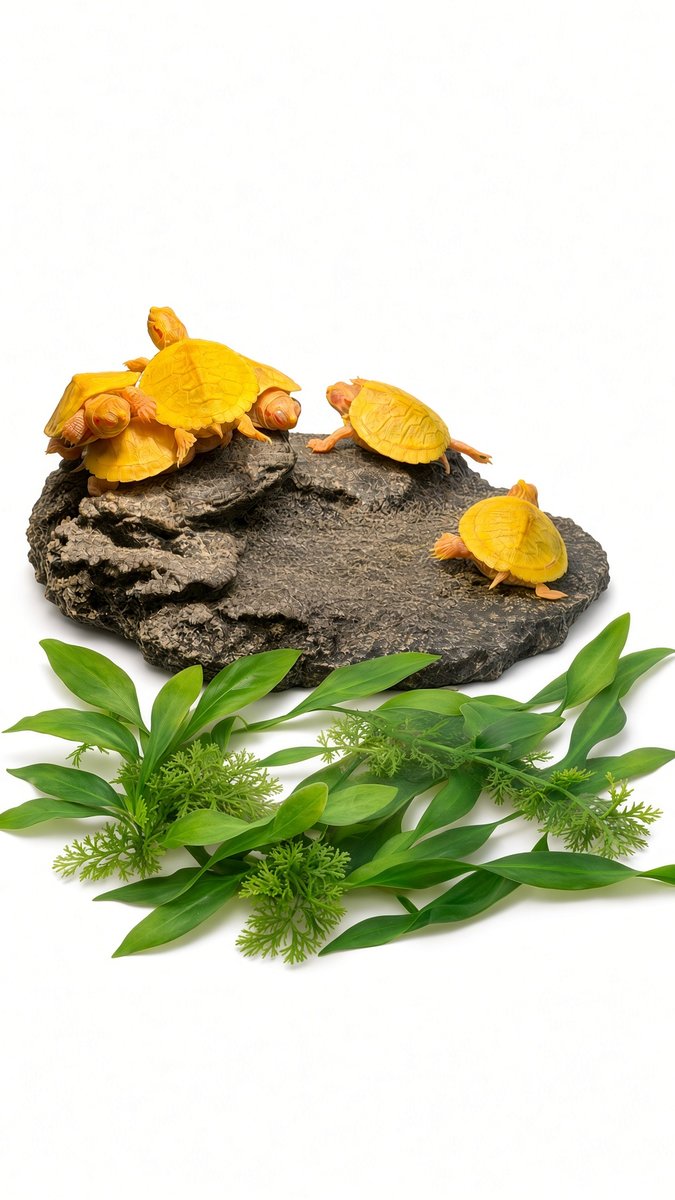
Albino red-eared sliders are a popular color morph of the classic RES. Care is the same as normal RES: warm water, dry basking dock, strong UVB, big filtration, and a diet that starts protein-rich and becomes more plant-based with age. Albinos appreciate shade options because bright light can be intense for them.
Enclosure
- Hatchlings may start in ~20–40 gallons temporarily; plan 75–125+ gallons for adults (females especially get large).
- Rule of thumb often cited: generous gallons per inch of shell — bigger is better.
- ~70% water / ~30% stable dry dock they can fully climb onto.
- Canister/pond-rated filtration; weekly partial water changes.
Water / Temps
Substrate
Bare-bottom is easiest to clean. If using substrate, choose large river rock bigger than the head or fine sand maintained carefully. Avoid small gravel that can be swallowed.
Lighting / UVB
UVB is required indoors for vitamin D3/calcium metabolism (separate UVB + heat or a quality mercury-vapor bulb). ~10–12 hour photoperiod. Provide shaded zones — important for albinos. Replace UVB bulbs on schedule.
Diet & feeding amounts
- Babies: Feed daily. A common portion guide is about as much pellet/protein food as would fit in their head, plus greens offered.
- Juveniles: Daily or most days; increase greens.
- Adults: Pellets/protein often ~3× weekly; leafy greens/aquatic plants daily; avoid obesity.
- Feed in a separate tub when possible to keep the display tank cleaner.
Guppies (and similar livebearers) as an occasional treat: Guppies are generally considered lower-risk for thiaminase than goldfish/rosy reds and can be an enrichment feeder occasionally — not a daily staple. Only use healthy fish from a clean, quarantined source (ideally home-cultured or from a known-healthy tank). Still gut-load/condition them and keep fish as a small part of a balanced turtle diet built around quality pellets, invertebrates, and appropriate plants/greens.
Foods they love
- Quality aquatic turtle pellets
- Earthworms, gut-loaded insects
- Dark leafy greens (collard, mustard, dandelion), aquatic plants
- Occasional feeder guppies from clean stock
Foods to AVOID (and why)
- Goldfish/rosy reds as staples: thiaminase → B1 deficiency; fat; pathogens.
- Only protein forever: adults need more plants; kidney/obesity issues.
- Iceberg lettuce, candy, bread, processed people food
- Wild duck-pond water plants of unknown pesticide exposure
What not to do
- Don’t keep without UVB/basking heat.
- Don’t use a tiny bowl “kit” for years.
- Don’t release RES into Florida waters (invasive/illegal in many contexts).
Health signs
Swollen eyes, soft shell, pyramiding, shell rot, wheezing, buoyancy problems, and appetite loss need veterinary attention. Salmonella hygiene: wash hands, don’t clean tanks in kitchen sinks.
Quick facts
Learn more: the red-eared slider and its albino morph
The familiar pet-shop slider is biologically complex: a temperature-sexed, strongly freshwater-adapted turtle whose popularity has also made it one of the world’s most widespread introduced reptiles.
Names, taxonomy, and close relatives
The red-eared slider is Trachemys scripta elegans, a subspecies of the pond slider within family Emydidae. Its closest forms include the yellow-bellied slider and Cumberland slider. The red mark behind each eye gives the normal morph its name. Older males can darken substantially, and albinism removes the normal melanin-based color pattern while leaving the same underlying species and care requirements.
Native range and habitat
Its native range centers on the Mississippi River drainage and nearby waters of the central United States. It uses ponds, lakes, marshes, sloughs, quiet river margins, canals, and other freshwater with basking sites, aquatic vegetation, and soft bottoms. Released pets have established populations far beyond that range on multiple continents, competing with native turtles for food and basking space and potentially introducing disease.
Conservation versus invasive status
The species remains widespread in its native range, but “common somewhere” does not make releases harmless elsewhere. Florida lists red-eared sliders as a Conditional nonnative species. Ordinary sliders generally require a permit for personal possession, with secure containment and egg-removal requirements; Florida separately exempts albino, amelanistic, and other distinctive aberrant-color specimens from the ordinary personal-possession permit requirement. That exemption is not a blanket authorization for every commercial or interstate transaction; breeders, aquaculturists, sellers, and transporters must follow the licensing, aquaculture, and recordkeeping rules that apply to their activity. Rules can change, so verify current FWC conditions before acquiring or transporting one. Never release a pet, its eggs, or tank contents into local water.
Anatomy and useful adaptations
- Streamlined shell: The relatively low, hard carapace and hinged front plastron aid swimming and partial closure; most turtles cannot completely hide every appendage.
- Powerful limbs: Webbed feet and claws propel the turtle and help it climb haul-out sites.
- Basking physiology: Leaving the water allows warming, drying, and ultraviolet exposure. Heat supports activity and digestion; UVB supports vitamin D production and calcium use.
- Underwater endurance: Sliders can stay submerged for long rest periods and exchange gases across specialized surfaces, but every turtle still needs unobstructed access to atmospheric air.
Size, growth, sex differences, and lifespan
Adults commonly reach roughly 12.5–28 cm (5–11 in), with females usually larger than males. Mature males have notably long foreclaws and longer, thicker tails. Growth depends on nutrition and temperature but should be steady, not forced. Well-managed sliders can live 20–40 years or longer. Research on slider vision supports color discrimination extending into ultraviolet wavelengths. Smell and taste aid feeding, and visual or vibration cues alert them to approaching animals.
Wild diet and behavior
Juveniles consume more animal prey—insects, small aquatic animals, carrion, and other available protein—while adults eat more aquatic plants and algae. They remain opportunistic rather than strict herbivores. Groups often stack on favored basking logs. When startled, they slide quickly into water; this escape response explains the common name. Courtship involves the male swimming backward near the female and vibrating his elongated foreclaws near her face.
Reproduction and incubation
Females leave water to excavate nests in sunny soil. Clutches commonly contain roughly 2–20 eggs, with larger clutches reported; one to several clutches may occur in a season. Incubation commonly lasts about 60–95 days, subject to temperature and weather. Temperatures during a critical developmental window determine sex: cooler incubation favors males and warmer incubation favors females, with mixed outcomes in between. This is developmental biology, not something a keeper can infer from a hatchling’s color.
Albinism and responsible genetics
Albinism is a loss of normal melanin production rather than a separate species. Different captive albino strains may involve different recessive alleles, so breeders must document the exact line instead of assuming all pale sliders are genetically compatible. A reputable breeder’s lineage records determine expected ratios; randomly mixing different strains can produce normally pigmented carriers rather than the anticipated albinos. Albino skin and eyes lack normal melanin, and shade is especially useful because intense light can be uncomfortable. “Amelanistic,” “leucistic,” “hypomelanistic,” and unrelated pattern mutations should not be treated as interchangeable labels.
Temperament and handling
Many sliders become eager at feeding time but do not seek human affection. Regular hands can become associated with food, so feed with care and never encourage finger nipping. Support from below with both hands, keep sessions brief, and return the turtle to water before it struggles. Avoid small children handling without close supervision; wash hands afterward and keep turtle equipment out of kitchen areas.
Health issues and early signs
- Vitamin A or nutrition problems: Swollen eyes, repeated respiratory illness, poor skin quality, and unbalanced growth can follow an impoverished diet; do not inject vitamins at home.
- Metabolic bone disease: Soft shell, deformity, weakness, or fractures call for urgent correction of lighting, calcium, and veterinary care.
- Shell infection and injury: Pitting, soft foul-smelling areas, bloody lesions, or retained damaged scutes need assessment.
- Respiratory or systemic illness: Wheezing, nasal bubbles, inability to submerge normally, persistent tilt, and appetite loss are red flags.
Real-world husbandry lessons
A dry, easily climbed dock and correctly positioned UVB are as important as tank volume. Strong filtration does not replace water changes. Rotate safe greens before a young turtle becomes fixed on protein, monitor body condition, and use a separate feeding tub only if the transfer itself does not create stress. Replace weak or swallowed-gravel-prone décor, guard heaters, and secure lids. “Sun through glass” supplies little useful UVB, and small plastic bowls do not become adequate because the turtle is a baby.
Myths and memorable facts
- Myth: “It grows only to the size of its tank.” Fact: Restricted growth is illness, not safe size control.
- Myth: “A slider can live on pellets forever.” Fact: A varied age-appropriate diet and plant matter are important.
- Myth: “Albino means a different species.” Fact: It is a pigmentation morph of T. s. elegans.
- Fun fact: A wild slider may share a basking log with several others, stacking to make the most of limited warm space.